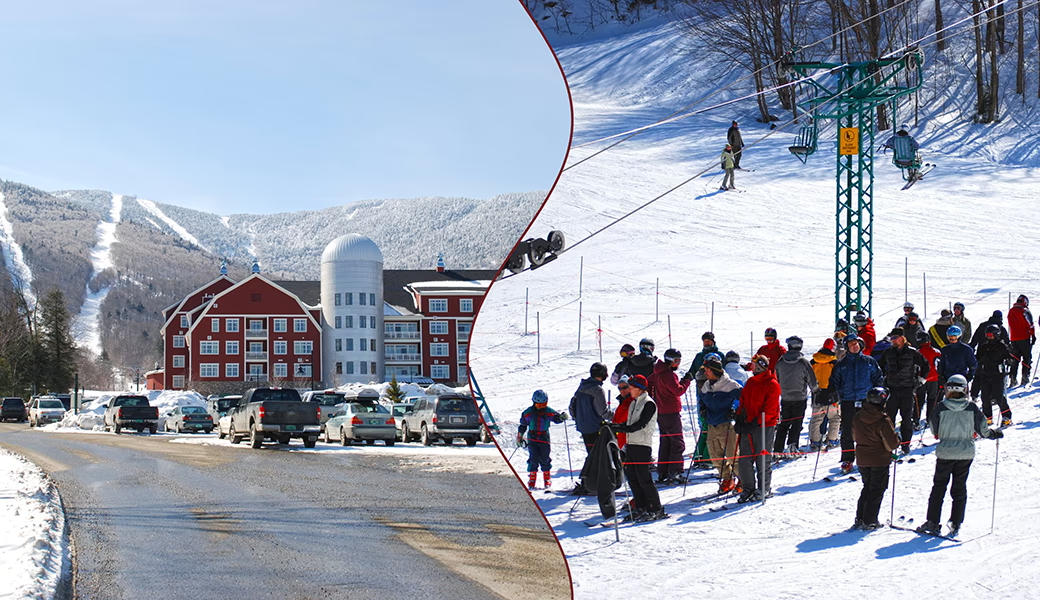
Skiers ask us this question before they ask about the room rate. Mad River Glen or Sugarbush? Both mountains sit near the inn, and guests have hashed out the choice at our bar since Sugarbush opened in 1959. Short version: these two mountains serve different skiers, and knowing the difference before you book saves you a wasted day on the wrong terrain. We’re not neutral here. We sit near both mountains and send guests to each one every week, and this is what we tell them.
The Short Answer
Mad River Glen rewards skiers who want the mountain on its own terms: steep lines, natural snow, uncrowded trails, no snowboarders. Sugarbush rewards skiers and riders who want options: multiple peaks, more groomed terrain, and enough lift capacity to keep a mixed-ability group happy all day. If you snowboard, the choice is made for you: Sugarbush, since Mad River Glen doesn’t allow it. If you ski black diamonds for fun and grumble when a trail gets groomed, book Mad River Glen. If you’re traveling with a family that spans beginner to expert, or this is someone’s first real ski trip, Sugarbush is the better fit.
Mad River Glen: Skiing the Way It Used to Be
Mad River Glen is skied by the shareholders who own it, a co-op with no outside owner to answer to. Snowboarding isn’t allowed. The mountain runs on four lifts, five counting the kids’ handle tow, but its identity comes from the Single Chair, the vintage lift that has served the upper mountain since 1949 and limits how many skiers can reach the top at once. Most trails get no snow-making at all, so what falls from the sky is what you ski on. That means MRG plays differently every visit: firm and fast after a cold snap, soft and forgiving after fresh powder, occasionally thin and rocky during a lean stretch. Trails stay uncrowded most days, though a powder day can mean an hour-long wait in the Single Chair line. The terrain stays narrow and natural, cut close to how it was decades ago, without the wide groomed boulevards you’ll find at bigger resorts. It’s not a mountain for a first-time skier, and it’s not trying to be. It’s a few minutes from our door, and we send serious skiers there constantly.
Sugarbush: More Peaks, More Room to Roam
Sugarbush spans four peaks: Gadd Peak, Lincoln Peak, Castlerock, and Mt. Ellen, though most visitors experience it as two connected mountains. Lincoln Peak is the original area; Mt. Ellen joined the resort in 1979 after years as its own ski area, Glen Ellen. The two sides are linked by the Slide Brook Express Quad, though it only runs when there’s enough snow on the ground beneath it to serve as an emergency evacuation route, so don’t count on skiing between them on a thin snow day. Most of Sugarbush’s terrain is groomed and welcoming, but Castlerock is the exception: narrow, natural, and steep, cut with the contour of the mountain, closer in spirit to Mad River Glen than to the rest of the resort. Snowboarders are welcome everywhere at Sugarbush, which settles the question for any group that mixes skiers and riders.
So Which One Is Right for You?
A few honest guidelines from staff who ski both mountains regularly:
- Snowboarding in your group? Sugarbush. Mad River Glen doesn’t allow it.
- Chasing steep, natural terrain and don’t mind a wait on a powder day? Mad River Glen, or Castlerock at Sugarbush.
- Traveling with a mixed-ability group or kids still learning? Sugarbush’s Lincoln Peak or Mt. Ellen.
- Want more trail variety across one day, snow permitting? Sugarbush.
- Can’t decide? Ski Sugarbush one day and Mad River Glen the next. We’ve had guests do exactly that on a single weekend.
Stay Near Both
Hyde Away sits close to both mountains, near enough that you lose no time getting to either one. We’re 1.9 miles from Sugarbush’s Mt. Ellen base, 4.9 miles from Lincoln Peak, and a few minutes from Mad River Glen. Come back to the tavern afterward for a beer by the fire and swap stories with whoever skied the other mountain. Planning a ski trip to the Mad River Valley? Book your stay at Hyde Away. We’ve been a base camp for Mad River Valley skiers since 1949.